Rhine or Danube for a First European River Cruise
Choosing between the Rhine or Danube for a first European river cruise is one of the most common questions we hear from travelers planning their maiden voyage on Europe's waterways. Both rivers deliver exceptional experiences, yet they differ in character, cost, cultural emphasis, and logistics. The Danube accounts for roughly 35-40% of all European river cruise bookings, making it the single most popular choice for newcomers, while the Rhine follows closely behind with its own devoted following. Your ideal pick depends on what excites you most: grand capital cities and thermal baths, or medieval castles perched above vineyard-covered slopes. This guide breaks down each river's strengths, compares real costs and schedules, and helps you match your travel style to the right itinerary, so you can book with confidence rather than guesswork.
Rhine or Danube: Choosing Your First European River Cruise in 2027
The decision between these two rivers is not about which one is "better." It is about which one is better for you, right now. Both the Rhine and the Danube rank among the world's most scenic waterways, and both are served by the industry's top cruise lines. Yet they offer fundamentally different experiences.
The Danube stretches 1,770 miles from Germany's Black Forest to the Black Sea, passing through or bordering ten countries. A typical cruise covers the most popular segment between Passau, Germany, and Budapest, Hungary, with stops in Austria and Slovakia. This means you are crossing multiple borders, sampling distinct cuisines, and witnessing architecture that shifts from Baroque to Ottoman-influenced within a few days.
The Rhine, by contrast, runs roughly 760 miles from the Swiss Alps to the North Sea. Most itineraries focus on the stretch between Basel, Switzerland, and Amsterdam, threading through France's Alsace region, Germany's castle-studded gorges, and the Netherlands' windmill-dotted lowlands. The distances between ports are shorter, the pace feels slightly more relaxed, and the scenery outside your cabin window changes almost hourly.
Both rivers are a strong fit for first-time river cruisers. The real question is whether you want a trip centered on world-class capital cities or one built around smaller, storybook towns and dramatic natural scenery. The sections that follow will help you answer that question with specifics.
The Danube: A Journey Through Central European Capitals
The Danube's greatest draw is its roster of capital cities. No other European river cruise delivers this concentration of major cultural destinations. You dock in or near Vienna, Budapest, and Bratislava, each offering full days of exploration without a single bus transfer from a remote port.
Vienna alone could fill a week: the Hofburg Palace, the Belvedere's Klimt collection, the Naschmarkt's food stalls, and an evening concert at the Musikverein. Budapest splits across the river itself, with Buda's hilltop castle district on one bank and Pest's grand boulevards on the other. Even Bratislava, often underestimated, rewards travelers with a compact old town, excellent local wine, and far fewer crowds than its neighbors.
Smaller stops add texture. Dürnstein, a tiny village in Austria's Wachau Valley, is where Richard the Lionheart was imprisoned in the 12th century. Today it is known for apricot schnapps and terraced Grüner Veltliner vineyards. Melk Abbey, perched above the river, houses one of Europe's most spectacular Baroque libraries. These smaller ports balance the intensity of the capital-city days.
Iconic Ports: Vienna, Budapest, and Bratislava
Vienna typically receives a full day and sometimes an overnight stay, giving you time for both structured excursions and independent wandering. Budapest often serves as the turnaround point, and many cruise lines offer an illuminated evening sail past the Parliament building, a highlight that consistently ranks among travelers' favorite moments on any river cruise.
Bratislava sits just 40 miles downstream from Vienna, making it an easy half-day stop. Its appeal lies in its walkability and authenticity. You will not find the tourist density of Prague or Vienna here, which is precisely the point.
Top Suppliers: Viking Longships vs. AmaWaterways Amenities
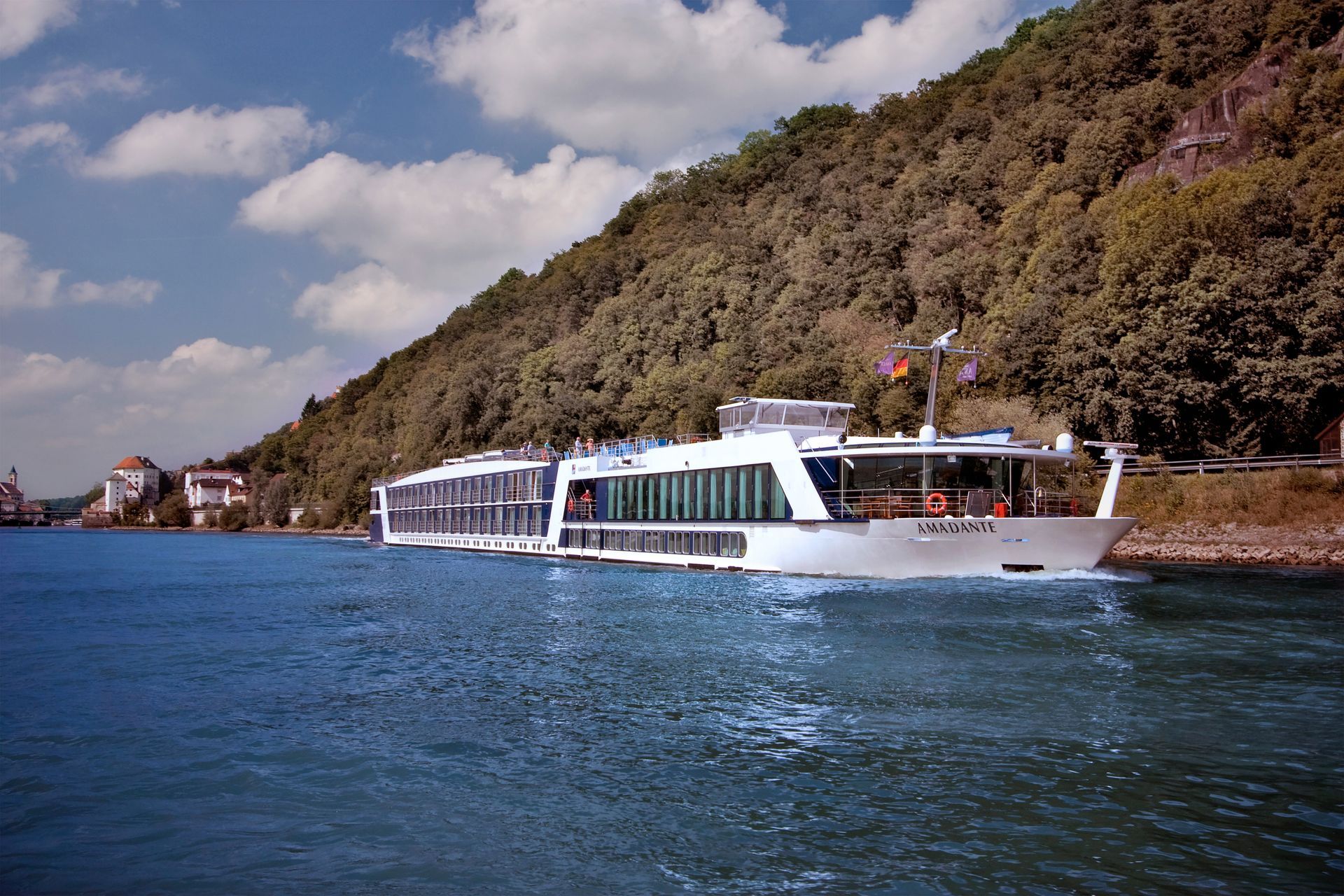
Viking River Cruises dominates the Danube with its fleet of Longships, each carrying 190 passengers. The ships are Scandinavian in design: clean lines, muted tones, and an emphasis on cultural programming. Included excursions at every port keep costs predictable.
AmaWaterways takes a different approach, with slightly smaller ships (typically 156 passengers), a stronger culinary focus, and a complimentary specialty restaurant called The Chef's Table. AmaWaterways also offers more active excursion options, including guided bicycle rides along the riverbank. If food and fitness matter to you, AmaWaterways has a clear edge. If you prefer a polished, predictable experience with strong value, Viking is hard to beat.
The Rhine: Castles, Cathedrals, and Fairy Tale Landscapes
The Rhine trades capital-city grandeur for intimate scenery and cultural charm on a smaller scale. Your ports here are places like Strasbourg, Rüdesheim, Koblenz, Cologne, and Kinderdijk, each with its own distinct personality. The pace feels gentler, and the ratio of scenic cruising to port time tilts more toward time on the water.
What the Rhine lacks in major capitals, it compensates for with visual drama. The river narrows through steep gorges, passes beneath fortress after fortress, and winds through some of Europe's most productive wine regions. If you have ever pictured a fairy tale European landscape with half-timbered houses and vine-covered hillsides, you were probably imagining the Rhine.
Strasbourg deserves special mention. This French-German border city blends both cultures in its architecture, cuisine, and language. Its Gothic cathedral took over 400 years to build and remained the world's tallest structure until 1874. The Petite France quarter, with its canals and timber-frame houses, is one of the most photographed neighborhoods in Europe.
The UNESCO Middle Rhine: 40 Castles in 40 Miles
The Upper Middle Rhine Valley earned UNESCO World Heritage status in 2002, and the reason is visible from your ship's sun deck. Between Koblenz and Bingen, you will pass roughly 40 castles in a 40-mile stretch, a density found nowhere else on the continent. Some are ruins. Others have been converted into hotels or museums. The Lorelei Rock, a steep slate cliff associated with a famous German legend about a siren luring sailors to their doom, marks the narrowest point of the navigable Rhine.
This section of the river is best experienced from the top deck with a glass of local Riesling. Most cruise lines schedule this passage during daylight hours, and onboard narration identifies each castle as you glide past. It is the single most iconic stretch of scenery on any European river.
Exploring the Black Forest and Alsatian Culture with Uniworld
Uniworld Boutique River Cruises positions itself at the premium end of the market, with individually decorated ships and an all-inclusive model that covers gratuities, premium beverages, and shore excursions. On Rhine itineraries, Uniworld offers excursions into the Black Forest from Breisach, including visits to traditional cuckoo clock workshops and tastings of Black Forest ham and kirsch.
The Alsatian excursions are equally rewarding. From Strasbourg, you can visit Colmar and its Unterlinden Museum, or drive the Alsatian Wine Route through villages like Riquewihr and Eguisheim. These are the kinds of smaller, character-rich destinations that define the Rhine experience, and Uniworld's included excursion program makes them accessible without separate planning.
Head-to-Head Comparison: Logistics, Cost, and Geography
Choosing between these two rivers becomes clearer when you compare them on practical terms rather than emotional ones. Both deliver outstanding experiences, but the logistics differ in ways that affect your budget, your schedule, and your comfort.
Geographically, the Danube's most popular segment (Passau to Budapest) covers roughly 600 river miles and typically takes seven nights. The Rhine's classic itinerary (Basel to Amsterdam) covers about 500 river miles over the same duration. The Danube crosses more borders, which adds variety but also means more currency changes if you venture off the ship in Hungary or the Czech Republic.
Flight logistics favor the Rhine slightly for North American travelers. Amsterdam's Schiphol Airport is one of Europe's best-connected hubs, and Basel is easily reached via Zurich or EuroAirport. Danube itineraries often begin or end in Budapest, which requires a connection through a European hub. This is not a dealbreaker, but it does add travel time.
Data Breakdown: Average Daily Rates and Seasonal Lock Closures
Average daily rates for a standard cabin on a seven-night cruise fall between $350 and $550 per person on both rivers, depending on the cruise line and season. Peak season (June through August) commands the highest fares, while shoulder months like April, May, September, and October often deliver better value and thinner crowds.
Lock closures are a practical concern that many first-time cruisers overlook. The Rhine's locks are generally well-maintained and rarely cause significant delays. The Danube, however, can experience low water levels in late summer and early fall, which occasionally forces ship-to-ship transfers or itinerary modifications. The Main-Danube Canal system connecting the two rivers involves 16 locks and can add scheduling complexity to combination itineraries.
Evaluating Shore Excursion Variety and Activity Levels
The Danube generally offers more variety in its excursion options because of the diversity of its ports. In Budapest, you might choose between a thermal bath visit, a food tour through the Central Market Hall, or a guided walk of the Jewish Quarter. Vienna offers everything from palace tours to Heuriger wine tavern evenings. The range is broad.
Rhine excursions tend to be more focused on scenery, wine, and small-town culture. Guided hikes through vineyard trails, visits to local wineries, and walking tours of medieval town centers dominate the options. If you prefer active excursions, both rivers accommodate that preference, but the Danube's larger cities provide more choices.
- Danube excursion highlights: thermal baths, palace tours, classical concerts, market visits, Jewish heritage walks
- Rhine excursion highlights: castle visits, wine tastings, Black Forest day trips, cathedral tours, cycling along the river
- Activity levels: both rivers offer gentle, moderate, and active options on most cruise lines
Selecting the Right Line: Scenic, Avalon, and Tauck Differences
Beyond Viking, AmaWaterways, and Uniworld, three other cruise lines deserve consideration for first-time European river cruisers.
Scenic operates all-inclusive ships with private butler service in every suite, a feature that distinguishes it from nearly every competitor. Scenic's ships also carry e-bikes, kayaks, and a small fleet of electric-powered Scenic Enrich experiences, such as private concerts in historic venues. The cost is higher, typically $500 to $750 per person per day, but the inclusions are comprehensive. If you want to avoid reaching for your wallet at any point during the trip, Scenic delivers on that promise.
Avalon Waterways takes the opposite approach to cabin design. Its Panorama Suites feature wall-to-wall, floor-to-ceiling windows that open to create an open-air balcony effect. This design maximizes natural light and river views without sacrificing interior space. Avalon's pricing sits in the mid-range, and its "Active Discovery" itineraries appeal to travelers who want more physical engagement with each destination, from painting classes to guided runs.
Tauck occupies a distinctive position by including all gratuities, excursions, and most beverages, while also incorporating exclusive access experiences. A Tauck Rhine cruise might include a private after-hours visit to a museum or a dinner in a castle that is closed to the general public. Tauck's ships are operated by Scylla, and the passenger count tops out at 130, creating a more intimate atmosphere. The cost per day is among the highest in the industry, but repeat booking rates suggest that travelers find the value justified.
Selecting the right line depends on what you value most: design innovation (Avalon), all-inclusive simplicity (Scenic), exclusive access (Tauck), cultural depth (Viking), culinary focus (AmaWaterways), or boutique luxury (Uniworld). We help NuVia Travel clients sort through these distinctions based on their specific preferences, budget, and travel style, because the "best" cruise line is always the one that fits you.
The Final Verdict: Which River Wins for Your Travel Style?
Neither river is objectively superior. The right choice depends entirely on what kind of traveler you are and what you want from your first European river cruise experience.
Choose the Danube if you are drawn to major cities, diverse cultures, and the thrill of crossing multiple borders. The Danube rewards travelers who love history, architecture, and the energy of places like Vienna and Budapest. It is also the better choice if you want maximum variety in your shore excursions.
Choose the Rhine if you prioritize scenic beauty, wine culture, and the charm of smaller European towns. The Rhine is ideal for travelers who want to spend more time on the sun deck watching castles drift past and less time navigating crowded city streets. Its slightly easier flight logistics for North American travelers are a practical bonus.
Either way, a well-planned first river cruise sets the tone for years of future travel. The key is matching the river, the cruise line, and the timing to your personal priorities, and that is exactly the kind of detailed, personalized planning that makes the difference between a good trip and one you will talk about for years. If you are ready to start narrowing down your options with expert guidance, Start Your Custom Journey and let us help you plan a first river cruise that fits your pace, your interests, and your budget.